Thomasclavelia
Formerly Erysipelatoclostridium.
Species in this genus
| Species | Healthy guts ↓ 0–100% | Products |
|---|---|---|
 Thomasclavelia ramosa Thomasclavelia ramosa | 0 | |
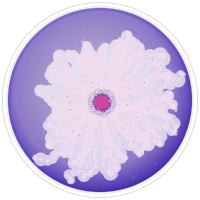 Thomasclavelia spiroformis Thomasclavelia spiroformis | 0 | |
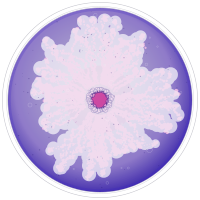 Thomasclavelia saccharogumia Thomasclavelia saccharogumia | 0 | |
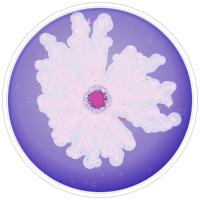 Thomasclavelia cocleata Thomasclavelia cocleata | 0 | |
| Across the genus | 0 |
* Counted in the same healthy people as the species (whole-genome samples). All bars use the same 0–100% scale. A product with two Thomasclavelia species counts once in the genus total.
Its species' DNA
Thomasclavelia genomes run from 2.5M to 3.5M: mid-sized for gut microbes.
One reference genome per species; strains vary.
16S gene, V4 region, from one reference sequence per species, aligned so the same positions line up. A blank is a gap: letters other species have and this one lacks. Switch to “Only where they differ” to fade the letters they share.
What its species can do
A species counts when most of its strains can. Not measured in anyone's gut.
- Can make lactic acid 3 of 4 species T. ramosa, T. spiroformis, T. cocleata
- Can use lactose 3 of 4 species T. ramosa, T. saccharogumia, T. cocleata
- Can ferment fiber 2 of 4 species T. ramosa, T. cocleata
- Can eat inulin 2 of 4 species T. ramosa, T. cocleata
- Can change bile acids 1 of 4 species T. ramosa
- Can make butyrate 0 of 4 species None of its species
- Can make propionate 0 of 4 species None of its species
- Can eat resistant starch 0 of 4 species None of its species
- Can eat pectin 0 of 4 species None of its species
- Can feed on gut mucus 0 of 4 species None of its species
- Can make B vitamins 0 of 4 species None of its species
- Can make hydrogen sulfide 0 of 4 species None of its species
- Can make methane 0 of 4 species None of its species
In healthy guts
In conditions
Compared with healthy people in the same studies, it’s less common in 2 conditions and more common in 10 conditions. Only studies that had both are counted.
A difference is an association: it doesn’t mean this microbe causes, prevents or treats any of these.
Strongest first, then the biggest gap · Each figure is 10 people