About
I’m Sav DeVarney. Probiome is my personal project, made with care and run by me, not a company. This page is how it came together: a case study in making the invisible lovable.
I studied microbiology because I’m a naturalist at heart: I like knowing who lives where, and why. Microbes let me ask it at every scale. They’re molecular enough to read letter by letter in a genome, and ecological enough that every gut is its own crowded, changing community. I fell in love with it, and though I don’t work in it anymore, I’ve never stopped being fascinated.
After my degree in microbiology and immunology, I spent 12 years making behavioural health products, then became a software engineer. Probiome is the first thing that’s asked for all of it at once: the microbiologist who wants to know what’s true, the behavioural scientist who wonders what brings people back, and the computer scientist who wants it to run cleanly and is curious about AI, and careful with it. It’s the most fun problem I’ve had.
Trillions of microbes live in each of us, and almost nobody knows their names. The research about them is huge, fast and easy to overstate. I wanted to know if one person, working with a team of AI agents, could make it something people enjoy exploring, without ever saying more than the studies do. Each chapter is one piece of that experiment: the question, what I expected, the rules I set, and what I’m watching for.
A visual identity for every microbe
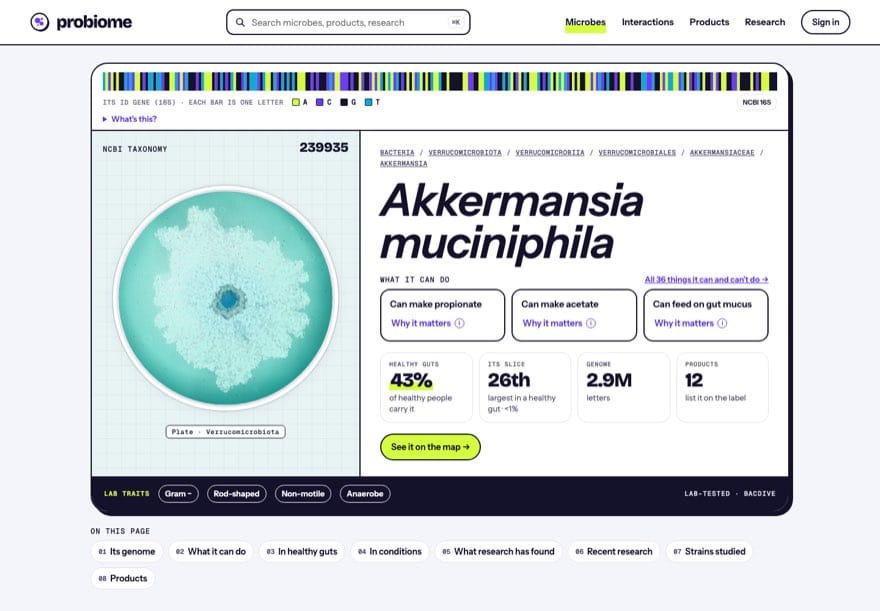
Before any chart, a visual identity. Each microbe grows its own plate, drawn from what labs know about it, and carries a barcode from its own DNA.
Would people care about gut microbes if each one had a visual identity of its own?
A visual identity drawn from a microbe’s real traits is more memorable than a list of associations, and it makes people want the details.
- Every input is real: phylum, cell shape, movement, its taxonomy id
- The drawing is decorative; it never encodes a measurement
- The same microbe grows the same plate, on every page and every device
- The drawing celebrates; the words stay exact
One plate generator shared by the site, the API and the pipeline, and an ID barcode drawn from the microbe’s 16S gene, four letters in four colours.

- Its ID barcode. The 16S gene, the sequence microbiologists use to tell species apart. Each bar is one letter: A, C, G, T.
- Its number. The NCBI Taxonomy id. It seeds the plate, so the same microbe always grows the same colonies.
- Its plate. Hue from its phylum, colony form from its lab traits. Decorative: it never encodes a measurement.
- Its traits. Gram stain, shape, movement and oxygen, lab-tested (BacDive). Rod-shaped and non-motile grows a bloom.
 Akkermansia muciniphila Verrucomicrobiota · teal Rod-shaped, non-motile → bloom
 Veillonella atypica Bacillota · violet Round cells, non-motile → cluster
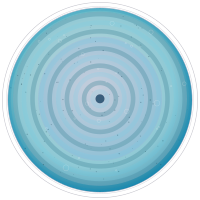 Escherichia coli Pseudomonadota · cyan Rod-shaped, motile → streak
 Faecalibacterium prausnitzii Bacillota · violet Shape not yet in the lab records → lawn
 Bifidobacterium longum Actinomycetota · magenta Rod-shaped, non-motile → bloom
 Eggerthella lenta Actinomycetota · magenta Rod-shaped, non-motile → bloom
 Akkermansia muciniphila
The spark: sports trading cards. A picture, a name, the stats on the back and one standout skill. The plate and the barcode are how that became real for microbes.
- Do people share them?
- Do the makers of products with these species use them to celebrate what’s inside?
- Do they help people learn who lives in their gut?
Fun, and safe to read
Words are a public-health tool. Probiome says what research found, and never gives advice.
Can a site about health be playful without casting meaning where there isn’t any?
If the rules for words are strict and written down, the design can be as playful as it likes.
- Describe, never advise
- Association is never cause
- Say how far a finding was tested, in plain words
- Never say what isn’t there
A rulebook built on GRADE and the microbiome reporting standards (STORMS), adapted for the public: banned words, an evidence ladder, “in 8 of 8 studies” counts.
- boosts immunity
- good bacteria
- heals your gut
- research shows
- you should try
- Higher in people who eat more fiber
- Its genomes can make butyrate
- Seen in one study of 1,200 people
- Fewer carry it, in 8 of 8 studies
- Tested in a trial of 32 people
- Does careful wording still feel like fun?
- Do people read “seen in one study” differently from “tested in a trial”?
A mountain of science, made explorable
A gut is an ecosystem, and its science is a web: thousands of microbes, metabolites, foods and conditions, joined by more than 30,000 links. One map, several depths, an address for each.
How much can you show at once before people stop understanding it?
Everything, if each depth answers one question and the next depth is always one tap away.
- Every dot is drawn; nothing hides behind a “show more”
- One question per depth
- Every view has its own address, so it can be shared and bookmarked
- Phones get the same map, not a lesser list
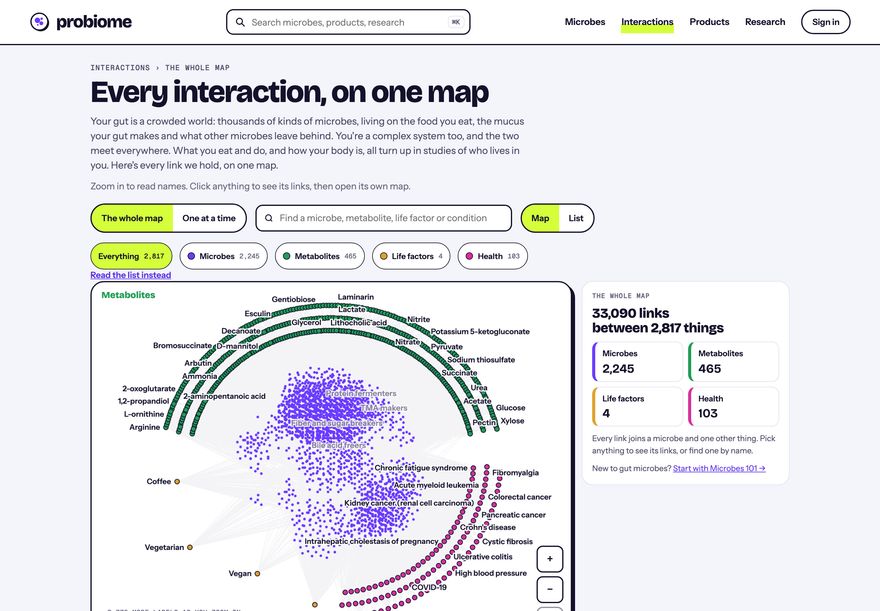
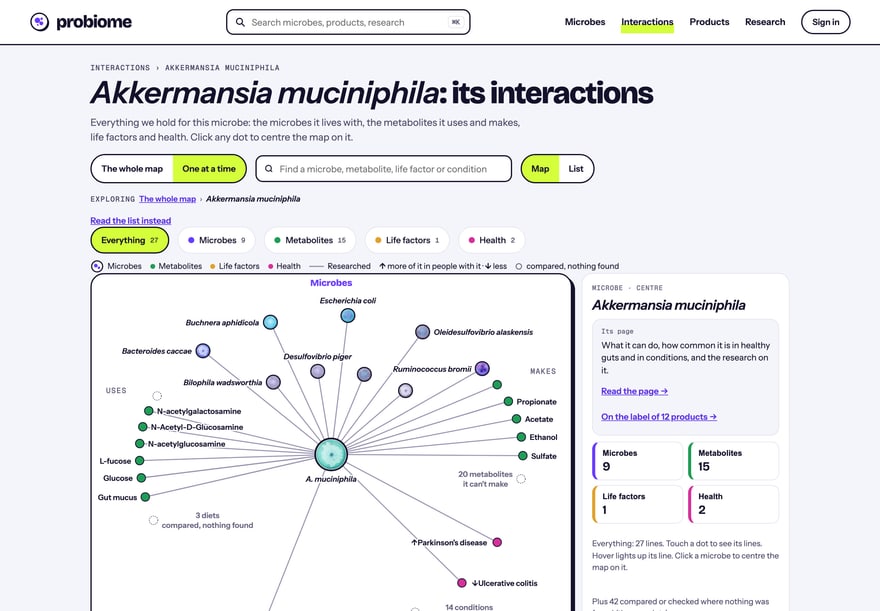
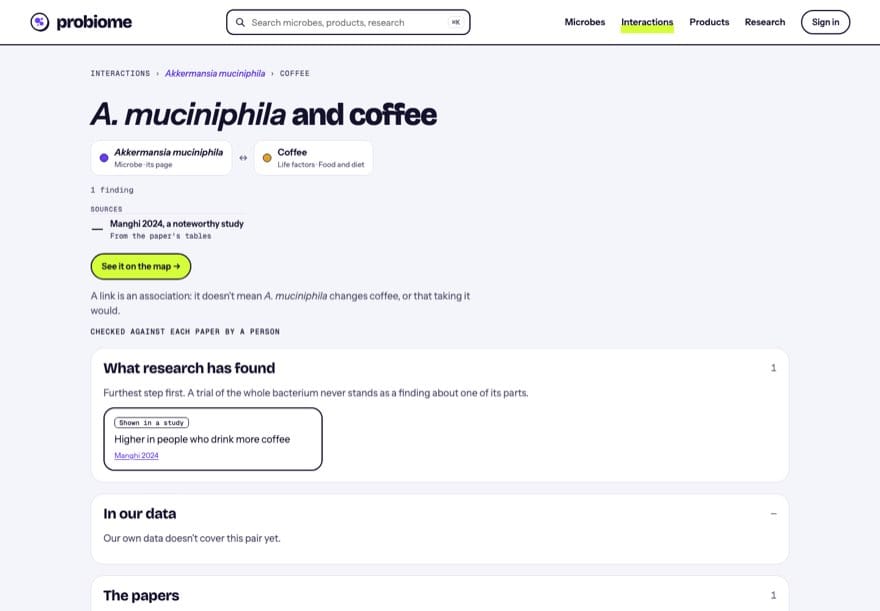
The interactions map: a whole view with named regions, a centre you can move, a page for every link and every microbe, down to the paper.
- 1The whole mapEvery dot drawn. Click any dot to light its links. Open its own map →
- 2One thing at the centreIts links, ringed around it, with ↑ and ↓ for which way. Click a line: Read about this link →
- 3One linkWhat research found, its sources, how it might work, the papers. Its page →
- 4The microbe itselfIts plate, its barcode, what it can do, its links, its products.


- Do people go deeper than the first view?
- Do they find their way back up?
Every shape means one thing
Some links are established, some early, some contested. Each gets one shape, and the panel says in words where it came from.
Can one map tell people where each link came from, without turning into a legend they have to study?
If every shape and colour has exactly one meaning, people read the map without the key.
- Solid means established; dotted means early; a zigzag means contested
- Where a finding came from is said in words, never in colour
- Violet means probiome.ai
- Details live in the panel, not on the lines
Every researched line draws the same. Pick one and the panel lists its sources, each saying how it came in: “from the paper’s tables”, “GMrepo’s analysis of this dataset”, “read from the abstract by probiome.ai”. How it might work lives in the panel only.
/interactions · one dot selected/interactions/akkermansia-muciniphilaThe dot you picked- Do people open the panel to see where a line came from?
- Do they read the lines without the key?
A pipeline that reads, a person who checks
About 40 new studies come out every day, and public datasets keep growing. A pipeline pulls both in, models read the papers, code decides what they’re worth, and a person checks before anything is shown.
Can an AI keep a public site current with the research, without the site ever repeating a model’s mistake?
If models only answer set questions and fill in forms, and code makes every judgement, the errors become checkable. Where two models disagree, a bigger model or a person decides.
- Models answer and extract; code decides grades and counts
- Disagreement means uncertain, however confident either model is
- Every sentence cites a paper we hold
- Everything is a draft until a person publishes it
- Say when probiome.ai did the work
A daily pipeline from PubMed and Europe PMC. Metadata sorts most papers for free; a decision model answers what metadata can’t, with a second model as a check; findings are extracted as structured fields (which microbe, more or fewer, in whom, how many people), graded by fixed rules, and reviewed. A probiome.ai byline names what the AI did: Counted, Read, Written.
- Research papers PubMed · Europe PMC · OpenAlex · PubTator New studies every day, and who wrote them
- Whole-gut datasets GMrepo · MicrobiomeHD Published results per microbe, nulls included
- What each microbe is NCBI Taxonomy · BacDive · AGORA2 · NJC19 Names, lab traits, and what genomes can make
- What’s on the shelf NIH Dietary Supplement Label Database Every supplement label sold in the US
If our own research ever goes public
Probiome’s first job is to explain other people’s research clearly. Anything we count or conclude ourselves stays research until it finds something worth showing, and nothing has yet.
If one ever does, it’s published first: a preprint on bioRxiv with its data and code on Zenodo, then open review if it holds up. Only then would it appear here, behind a switch that’s off by default, drawn in violet, labelled as ours, and never counted with published studies.
The likeliest first one isn’t a prediction. It’s a question about method: when you re-run public data one way, how often does it agree with what the authors reported?
- Does showing what the AI did make people trust it more, or less?
Predicting from what microbes are, someday
Could a model point at the links worth studying next: between microbes and conditions, but also the foods, medicines and habits around them, and the compounds microbes make? Maybe, someday. Here’s what it would take.
What would a model need before it could point at research worth doing?
Most of today’s data records what scientists chose to study. A model needs outcomes measured in people, nulls included, before its suggestions mean anything.
- Learn from outcomes in people, never from what gets published
- Beat a simple baseline, or show nothing
- A suggestion is never a finding
- Public research tables only, never anyone’s gut log
A relational model like Kumo’s, reading the whole web of microbes, conditions, factors, foods and compounds; or simpler graph methods, or plain models on what each microbe is. Each judged against a simple baseline: what its relatives do.
A model trained on papers learns what scientists pay attention to, and that follows funding, fashion, what grows easily in a lab and which conditions have patient groups behind them. So the target has to be what’s true in people, not what gets written about.
- 01 Whole-gut studies, with their nulls Many more studies that measure every microbe and publish what didn’t differ, dated by when they were deposited, so a model can be tested on a future it didn’t see.
- 02 Species, not just genus Shotgun sequencing at scale, so results reach species and strains instead of stopping at genus.
- 03 What each microbe is Genome-level qualities for most gut microbes, what each can break down, make and do, not just the well-studied few.
- 04 Real exchange Evidence of what microbes actually pass between them, not just records that each can make or use a compound.
- 05 How people live, in the same people Diet, medicines and habits measured alongside the microbiome, so a model can tell a condition from what people do about it.
- 06 Adjusted, published results Per-microbe results adjusted for age, sex, medicines and sequencing depth, since that’s what a model should learn from.
If predictions ever earn a place
ConceptNone of this switches on until a test on the past beats simple guesses on outcomes measured in people. If one ever does, this is how a suggestion would look: plainly a question, never a finding, and off until you turn it on.
- Which of these gaps closes first?
- Would a suggestion help researchers, or just add noise?
Rating what you take
Thousands of probiotics are on the shelf, and almost nothing independent says how they went for the people who take them.
Will people rate the probiotics they take, honestly, with nothing in it for them?
If rating takes a minute, asks about the experience rather than “did it work”, and is never paid for, people will rate, and the totals will help the next person choose.
- Rate the experience, never efficacy: would you take it again, was it worth it, any side effects
- Every rating shows, negatives included; nothing is paid for, reordered or hidden
- Money never decides what’s promoted: no paid placement, stores listed A to Z
- Ratings sit beside the research, never inside it
- Say your connection to the brand; people the brand pays can’t rate
- Totals only from 10 or more ratings
The shelf comes from the US government: the NIH’s Dietary Supplement Label Database, read down to the strain and matched to the research. Where it stops, a Probiome editor fills the gaps by hand.
- Government data NIH’s label database Every dietary supplement label sold in the US, public and free (the Dietary Supplement Label Database). Thousands of probiotics, re-read every week.
- Code Read down to the strain Names on the label matched to species and strains, so each product links to the research on what’s inside.
- Probiome editor Filling the gaps Products the database doesn’t have, added from the maker’s own page and marked “Not in NIH DSLD”. Old labels flagged. “Can’t find it? Ask us to add it.”
- The page A product page What’s inside, the research on its strains, people’s ratings beside it, and where to buy.

The rating sheet on a phone, with sample answers for Daily Probiotic by Example Labs: would take it again, yes; value, so-so; side effects, gas, settled; taken three to twelve months and still taking it; a short note; no connection to the brand; and a Post rating button.
The product page after posting, with sample ratings: a banner saying Posted, then People’s ratings, 49 ratings, with your rating first and another person’s below it.
Where to buy
- Amazon$24.99Buy ↗
- iHerb$21.49Buy ↗
- The maker’s store$22.00Buy ↗
Listed A to Z, never by commission.
Probiome may earn a commission when you buy through these links. It pays for running Probiome, and will fund the Probiome Foundation (coming soon). It never changes what’s shown, how products are sorted, or what people rate. About the Foundation →
When someone buys through a store link, Probiome may earn a referral. Money never decides what’s shown or promoted: no product is featured, ranked or reordered for it, ratings are never touched, stores are listed A to Z, and it’s said under every link.
Where that money goes: the Probiome Foundation, chapter 11 →- Will people do it?
- Do the totals help the next person choose?
- Does it change what brands say on the label?
- Across many people, could ratings start to show which probiotics go well for whom?
Data without the survey
Ratings say what someone took and how it went. The gut log adds what was going on around it, day by day. What you eat, what you take and how you poop are what researchers most want to know, and what people least like reporting.
Can we collect daily data that usually takes long questionnaires, with no forms and no nagging?
A minute of conversation a day, in your own words, beats a perfect survey nobody finishes.
- Start with a conversation; the specimen is an attachment
- Your words, never forced into a category
- Learn “your usual” instead of asking for it
- Private by construction: never in a URL, a share image or analytics
A gut log that starts with a conversation: how is today, and what’s been happening since your last bowel movement, in your own words. A specimen (a photo, or one of seven types) is something you add, now or any time that day. Over time it learns your usual.
The gut log’s Today screen: "How is today?", "Since your last one · Mon, 7:55 am", and a box with a sentence already typed (a big bowl of lentil soup, a bit bloated, a long walk, a short sleep). Under it, "Add a specimen" is being tapped, and Send. "Only you see it."
1Say how today is One question: what’s been happening since your last bowel movement? Then add a specimen, like attaching a photo.The progress screen, "Reading your specimen", working through "Looking closely", "Reading its type" and "Getting your suggestion ready". It turns over to the suggestion, which is the result card itself: Specimen #0042, the glass, the color, type 4, Smooth and soft, "Read from your photo · is that right?", with "Yes, type 4" and "Pick another".
2Snap a photo, or just pick Take a photo and it reads the shape, then asks if it got it right. No photo? Pick the closest of seven types.A result card for Specimen #0042: the standard drawing of type 4, Smooth and soft, "Read from your photo, you confirmed", and a "Back to today" button. It flips in turn to "How we read it": a wireframe of the measured shape, what it saw, and how well each of the seven types matched, with type 4 the closest.
3Your specimen, drawn not photographed It’s drawn from your type, never your photo, with your color beside it. Flip it to see how it was read.The conversation, "Question 1 of 3": the person’s words, then the specimen they added shown like a sent photo (its drawing, "Type 4 · Smooth and soft", "Specimen #0042"), a line noting what it heard (lentils, a bit bloated, a long walk, short sleep, and a type 4), the things logged from it, and a question about yesterday. The messages arrive one after another.
4Back to your day Your specimen joins the conversation. It asks what it still needs, and the day stays open to add to.

Next, maybe: bring your own sequencing
ConceptLots of people already have a gut test result sitting in an email. I’d love the gut log to be a home for it: add the file, see who lived in your sample in Probiome’s plain words, and keep it private. If you’re in the research pool, you could also say yes to researchers who ask, one study at a time.
That’s the win-win. People get a clearer view of their own gut, beside the days they logged. Researchers get sequencing that comes with the day-by-day context surveys rarely manage. And the Foundation sits in between, keeping the promise to both.
The hard part is that every test sends something different. Open standards already exist for the pieces, so Probiome wouldn’t invent its own: read every file through one open pipeline, keep the result in standard formats, and carry each person’s consent with their data.
The Account screen with an offer card.
1An offer, not a nagOne card in Account for people who already have a result.The upload sheet for a sample file.
2Private by defaultAny common file. Who can use it is a choice, and Only me comes first.Your test: who lived in the sample.
3Read the same wayWho lived in the sample, linked to each microbe’s page. No score, no comparison.A sample study request, not a real study.
4One study at a timeA study asks, says what it would use, and takes no for an answer.


- Do people keep logging after the first weeks, with no reminders?
- Would people add a test they already paid for, and share it with a study that asks?
A hall of fame for good days
A concept. People are oddly proud of a great poop, so I built a way to share one. Then I switched it off.
Would people share a great day, the way they share a personal best?
If a share is a drawing, never the photo, plus a sentence in their own words, some people will. And a shelf of good days, browsable by diet, habits and product, could be the next level of a product rating.
- The photo stays private; the share is a drawing
- In their own words, never a claim about health
- One person’s day, never evidence
- A concept: built, then switched off
I designed and built it: share a specimen as a drawing, with what you say helped and the probiotic you take, and browse everyone’s shares by type, by what people noted, and by product. It’s switched off for now.


Why I probably won’t ship it
It was a fun one to design. But a shelf of proud poops, each beside the probiotic someone took, quietly says “take this for the best poop of your life”. That isn’t what probiotics are about, or what the science says.
What gut microbes do for a body is far more intricate than what ends up in the bowl. One Bristol number with a product beside it would undo what the rest of Probiome is trying to show.
Under the hood
How it’s built: the science is worked out ahead of time, served from the edge, and every model can be swapped.
Can a research-grade data platform and a consumer health app run as one system, fast and nearly free?
Compute the science ahead of time in batch, serve it from the edge, keep every model behind a port, and the system stays fast, cheap and safe to change.
- Work out the data ahead of time, never per visit: every page has a query budget
- One service layer, many doors: GraphQL, MCP and chat share it
- Content a person might edit lives in git; data lives in Postgres
- Every model is swappable, and chosen by an eval on our own cases
- Private by construction: your log never reaches a cache, a URL or a share
Cloudflare at the edge (one gateway Worker, Workflows, a Durable Object, Workers AI, R2), Postgres behind it, a batch pipeline on GitHub Actions, and a monorepo of TypeScript packages shared by the site, the API and the pipeline.
- SvelteKit, installable on a phone
- d3-force for the maps
- Ratings queue offline and send when back (TanStack Query, IndexedDB)
- Ask Probiome through MCP
- Public tools for everyone; your gut log only with your OAuth sign-in
- An agent over AG-UI
- Reads your words, suggests chips; you confirm
- Hono → GraphQL (Yoga + Pothos), MCP and AG-UI
- One service layer behind every protocol (TSyringe, ports and adapters)
- No introspection, masked errors, CORS to the site
- Workflows read a photo step by step
- A Durable Object streams each step to the screen
- Crons for the daily jobs
- Workers AI: the photo gate and reader, short replies, labels
- R2: private photos
- staging → core → serving, all SQL
- Full-text and vector search together
- Your log in its own schema; Hyperdrive in front
- Runs on GitHub Actions, daily and on merge
- PubMed, Europe PMC, OpenAlex, PubTator, GMrepo, AGORA2, BacDive
- Decision models answer set questions about each paper
- Preflight stops a run before any download if a migration is missing
- Curated YAML, field notes, AI summaries as files
- Drafts arrive as a pull request; merging publishes
- Evals with dated reports and committed baselines
apps/web, apps/api, packages/pipeline, packages/art (the plates and specimens, drawn the same everywhere) and packages/tool-ui (cards shared by the site and MCP).- Does it keep running smoothly as the data and the visitors grow?
- Do the query budgets hold when the map doubles?
- Could a second engineer find their way around it in a day?
The Probiome Foundation
Coming soonProbiome reads other people’s science every day. The Foundation is how it gives back: a public educator, an aggregator of published research, an AI lab that publishes what it tries, and a funder of what comes next.
What structure lets one project educate the public, run its own AI research and fund other people’s, and stay honest doing all three?
If the money people’s choices generate flows back to the science they read, and never into what they’re shown, everyone has a reason to keep it honest.
- Educate with published results only
- Our own AI research is published, labelled and opt-in
- Money never decides what’s shown, ranked or rated
- Give back to the people who keep the data
- Fund questions, never answers
- Open about where the money goes
The Probiome Foundation, a nonprofit, coming soon. Referral money pays for running Probiome first. Anything beyond that gives back to the people who maintain the public datasets Probiome is built on, and funds researchers willing to look at what the research leaves open, including the questions our own published AI research points to.
- 1 People read, rate and choose Published research, explained; honest ratings of what people take.
- 2 Some buy through a store link A referral, never a reason to rank anything.
- 3 The Foundation runs Probiome Servers, data and the tools that read and check papers.
- 4 It gives back to the data Support for the people who maintain the public datasets every page is built from.
- 5 It funds the open questions Grants and scholarships for researchers willing to study what research leaves open, including questions our own published AI research points to.
- 6 New research is published And comes back to Probiome as published results, for the next person to read.
- Would dataset maintainers and labs want to work with it?
- Can funding questions stay separate from funding answers?
For everyone who keeps this science going
The researchers, the people who maintain the datasets and the labs asking new questions are already doing the work Probiome stands on. The Foundation is a way to give some of it back. If that’s you, I’d love to hear from you: hello@probiome.io.